
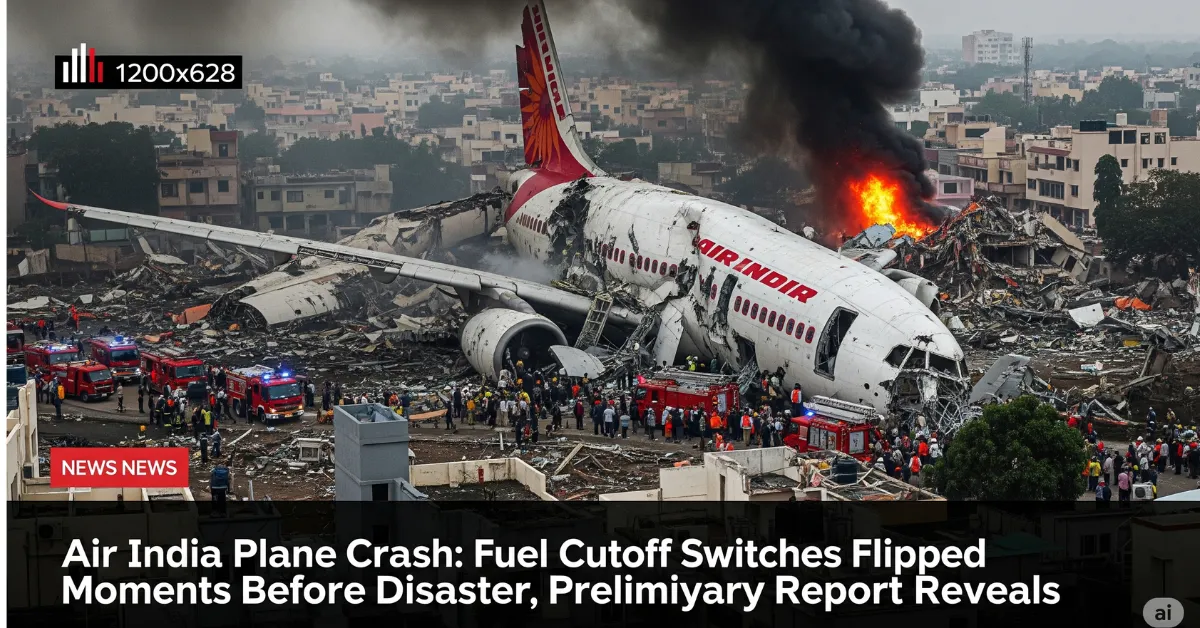
The aviation world is grappling with the shocking preliminary findings of the Air India Flight AI 171 crash, which reveal that the Boeing 787-8 Dreamliner’s engines lost fuel supply just seconds after takeoff, leading to the tragic loss of 260 lives on June 12. While India’s Aircraft Accident Investigation Bureau (AAIB) has shed light on the immediate sequence of events, their report leaves critical questions unanswered, prompting a deeper look into the broader implications for international aviation safety.
The AAIB Report: Key Findings and Shocking Details
The AAIB’s preliminary report confirms a chilling scenario. According to data extracted from the flight’s black box, the fuel cutoff switches for both engines moved from the “RUN” to “CUTOFF” position within a mere second of each other, just moments after the aircraft lifted off from Ahmedabad. This abrupt interruption to the fuel supply caused a rapid loss of thrust, sending the Boeing 787, bound for London Gatwick, plummeting to the ground.
Compounding the tragedy, cockpit voice recordings captured a crucial and perplexing exchange: one pilot is heard asking, “Why did you cut off?”, to which the other responds, “I did not do so.” This exchange underscores a profound confusion in the flight deck, directly preceding the “MAYDAY” call and the subsequent impact. The report also notes the immediate deployment of the Ram Air Turbine (RAT), an emergency power source, signaling a critical loss of primary electrical power. The engines were later retrieved and quarantined as part of the ongoing investigation, with fuel samples from the aircraft found to be satisfactory.
Unpacking the Mystery: Human Error, Technical Glitch, or Design Flaw?
The most pressing question arising from the AAIB’s preliminary findings is the why. How did the fuel cutoff switches for both engines transition to the “CUTOFF” position without apparent command or intention from the pilots? Investigators are now focused on three primary theories: human error (either deliberate or inadvertent), a mechanical failure within the switch mechanisms, or a potential underlying design flaw in the aircraft’s systems.
Experts weigh in on the complexities of distinguishing between Pilot Error vs. Mechanical Failure. While the cockpit recording suggests neither pilot acknowledged initiating the cutoff, the physical proximity of the switches makes an accidental simultaneous movement improbable for a single individual. The possibility of an unknown technical malfunction, a system glitch, or even a subtle design characteristic that could lead to such an event is under intense scrutiny. The implications for the widespread Boeing 787 Dreamliner Incidents database and overall fleet perception are significant, as global operators await a definitive cause.
Global Aviation Safety: What Does This Report Mean for the Skies?
The Air India crash report, though preliminary, casts a shadow over existing Aviation Safety Standards and calls for heightened vigilance across the industry. While the AAIB has not yet issued immediate recommendations for B787-8 operators or engine manufacturers, the unanswered questions raise concerns about the integrity of critical flight controls.
A deeper understanding of what caused these switches to move is paramount. If it points to an undetected system vulnerability, it could lead to global airworthiness directives, mandatory inspections, or even design modifications across the Dreamliner fleet. Conversely, if human factors are ultimately determined to be the cause, it would necessitate a re-evaluation of pilot training protocols and cockpit procedures. The outcome of the full investigation could therefore trigger significant changes in how airlines operate and maintain their aircraft, impacting passenger safety worldwide.
Looking Ahead: The Path to Clarity and Enhanced Safety
The preliminary report serves as a critical first step, but the comprehensive investigation is far from over. Future phases will involve in-depth analysis of recovered components, detailed examination of flight data recorders and cockpit voice recordings, and ongoing collaboration with Boeing and General Electric (the engine manufacturer). The aviation community will be closely watching for the final report, hoping it provides definitive answers to prevent a recurrence of such a devastating event.
The quest for clarity is not merely about assigning blame but about enhancing safety. Every incident, no matter how tragic, offers invaluable lessons. The Air India crash, with its perplexing fuel cutoff mystery, will undoubtedly contribute to the evolution of flight safety protocols, ensuring that the skies remain as safe as possible for travelers globally.
Find daily trending topics and trending news of https://usahottopics.com
Resources for Fact Check:
- [Link to AAIB Preliminary Report (if publicly available and specific to the report)]
- [Link to official Air India statement regarding the crash]
- [Link to Boeing’s official statement on the investigation]