
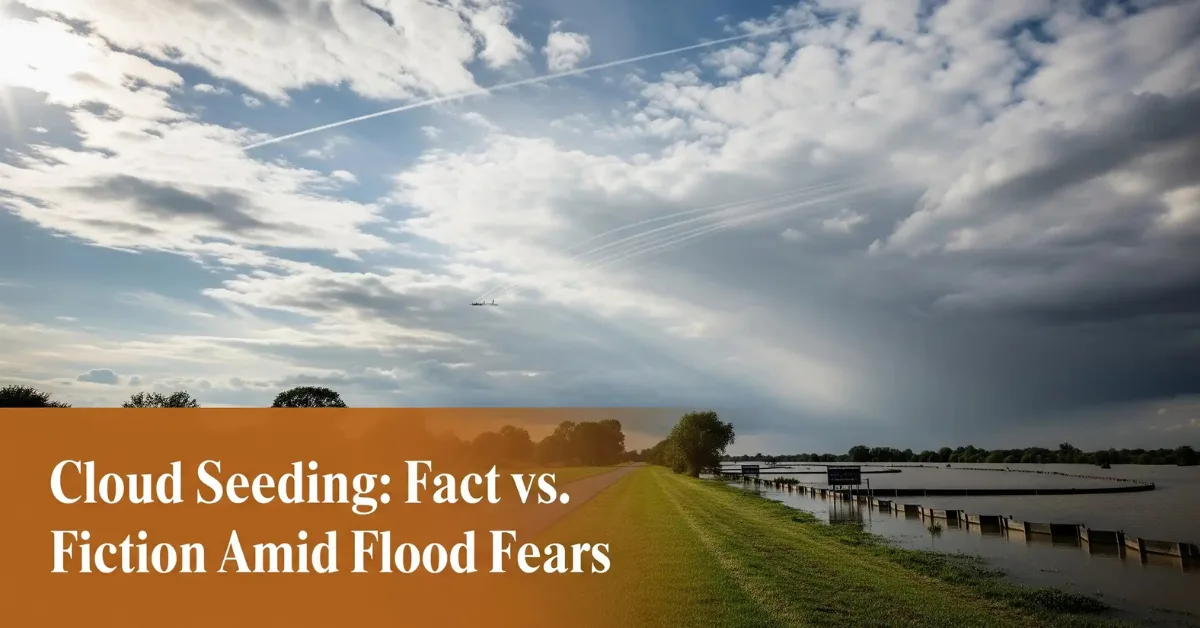
Following tragic and powerful floods in Texas and New Mexico, the term “cloud seeding” has exploded across social media, often tied to baseless conspiracy theories about governments engineering man-made disasters. This surge in misinformation has left many Americans wondering what this technology is and what it’s capable of.
This article cuts through the noise to provide the facts. We will debunk the dangerous myths surrounding weather modification, explain the real science behind how cloud seeding works, detail why it’s actually used in the United States, and cover the legitimate scientific debates about its effectiveness and safety.
Debunking the Myths: What Cloud Seeding Cannot Do
Let’s be clear: the recent conspiracy theories linking cloud seeding to catastrophic floods are unfounded. Current cloud seeding technology cannot create storms, steer hurricanes, or generate the massive, widespread deluges seen in recent natural disasters.
The scientific reality is that cloud seeding is a tool for enhancement, not creation. It can only work on existing, suitable clouds that are already on the verge of producing precipitation. The goal is to make them slightly more efficient, aiming to increase rainfall or snowfall by a modest amount, typically in the range of 5% to 15%. The energy contained within a major storm system is immense, dwarfing anything that can be influenced by current seeding methods. The idea that seeding can conjure a deadly flood is pure fiction.
How Cloud Seeding Actually Works (The Real Science)
So, if it’s not a superweapon, what is it? Cloud seeding is a scientific process that aims to give mother nature a small boost. Clouds are made of tiny water droplets or ice crystals, but they need something to cling to—a “condensation nucleus”—to grow heavy enough to fall as rain or snow.
In many clouds, these nuclei are in short supply. Cloud seeding introduces tiny particles, most commonly silver iodide, into these clouds to serve as additional nuclei. Dispersed by aircraft or from ground-based generators, these particles have a crystalline structure similar to ice, encouraging water droplets to freeze onto them. Once these new ice crystals grow large and heavy enough, they fall from the sky, often melting into raindrops on their way down.
The Real Reasons States Use Cloud Seeding
While conspiracy theorists imagine nefarious purposes, the actual applications of cloud seeding in the United States are far more practical and focused on a single critical resource: water. The primary and most common use is for drought relief, especially in the arid Western states.
For decades, states like Colorado, Utah, Idaho, and California have run cloud seeding programs aimed at increasing mountain snowpack during the winter. This “frozen reservoir” of snow is vital, as its gradual spring and summer melt-off replenishes rivers, streams, and reservoirs that provide drinking water and irrigation for millions of people and vast agricultural regions. Other, less common uses include hail suppression to protect valuable crops and fog dispersal at airports to improve visibility and safety.
The Legitimate Debate: Is It Effective and Safe?
While cloud seeding is not a conspiracy, it is the subject of legitimate scientific and policy debate. For years, scientists have argued over its statistical effectiveness. Proving exactly how much additional rain or snow was caused by seeding—versus what would have fallen naturally—is an incredibly complex challenge. While recent studies have provided stronger evidence of its success, the exact return on investment remains a topic of research.
There are also valid questions about the environmental impact of depositing silver iodide. However, numerous studies conducted over decades have generally concluded that the trace amounts used have no demonstrable negative impact on the environment, soil, or water supplies. The real conversation about cloud seeding should be about these practical questions of efficacy, cost-effectiveness, and long-term environmental stewardship.
Find daily trending topics and trending news of USA at www.usahottopics.com.
Resource Links (for fact-checking):